The ACT is undergoing significant changes. These enhancements aim to improve the test-taking experience, ensure score consistency, and align the exam more closely with current educational standards. Here, you will find all the changes coming to the ACT, addressing key questions and concerns from educators, students, and parents.
This article is part of a more extensive series on the Enhanced ACT. Based on the updates the ACT makes available, much of its content might change as more announcements come from ACT.org.
Table of Contents
- Change #1: More Time Per Question
- Change #2: Shorter Test
- Change #3: Optional Science Section
- Change #4: Less Reading
- Change #5: Question Content
- Ensuring Score Consistency
- Field Test Items: Placement and Scoring
- Impact on Previous Scores and Superscores
- Concordance Between ACT and SAT Scores
- Availability of Practice Materials
- Testing Platforms and Tools
- Rollout Schedule: When ACT Enhancements Will Take Effect
- International Testing Options
- Alignment of PreACT and WorkKeys Tests
- Reporting Science Scores
- Questions Test-Prep Experts Have About the Enhanced ACT
- Takeaways from the New ACT Changes
- Article Summary
- About the Authors
Change #1: More Time Per Question
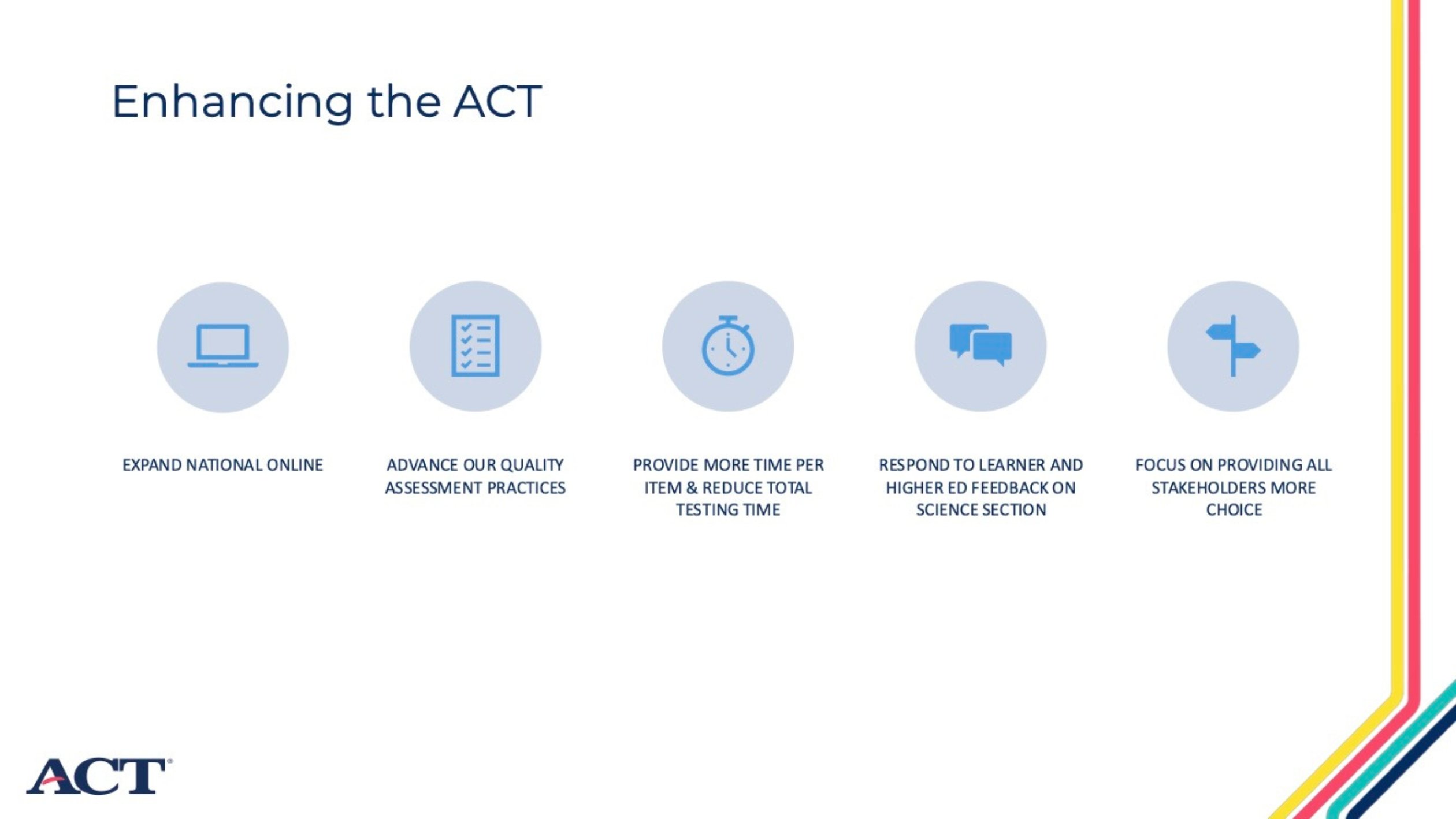
The average time per question will increase by approximately 10 seconds across various subjects, giving students more time to complete each question.
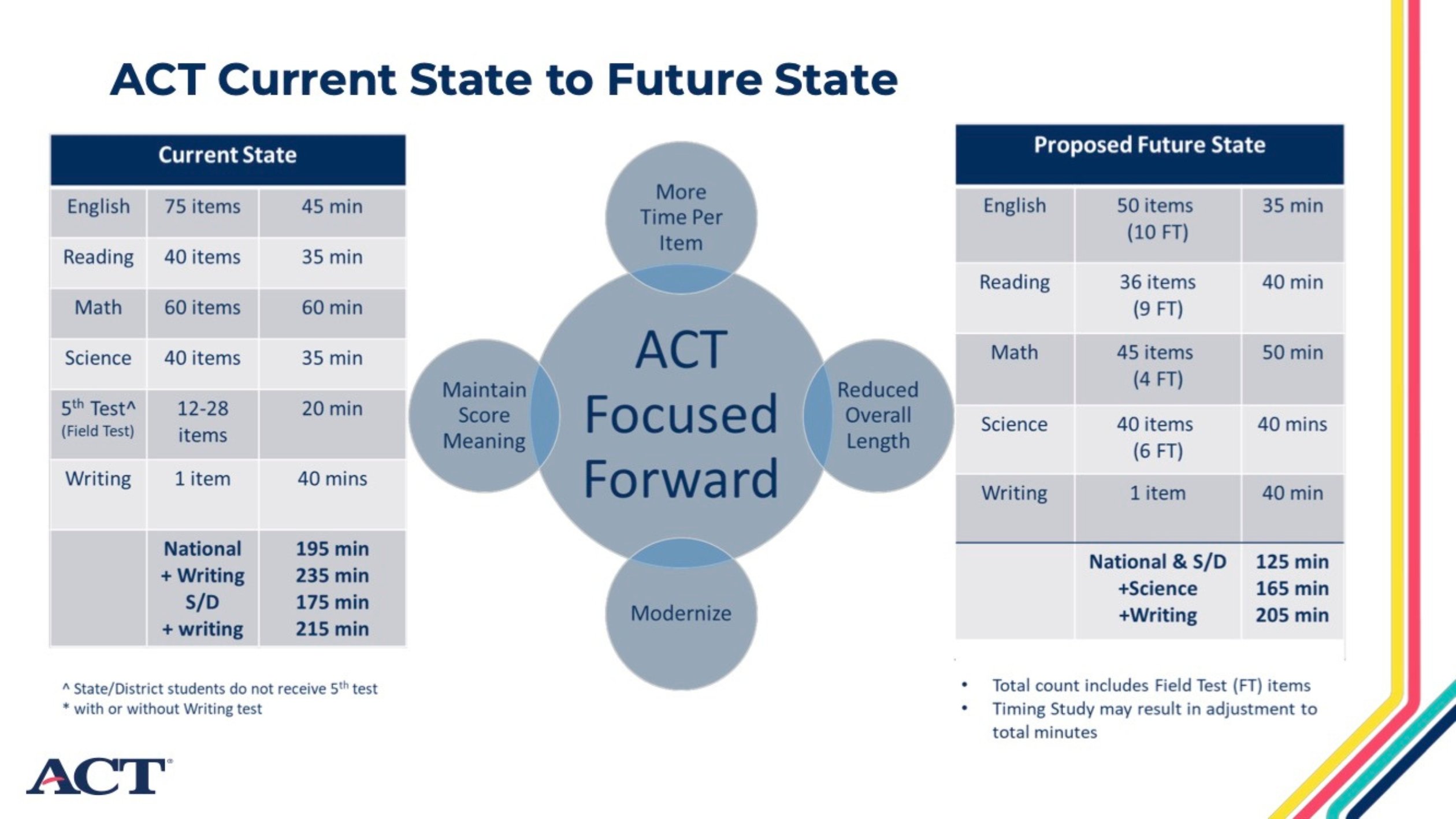
The ACT has provided an estimated time per question for each subject in the new format:
- English: 42 seconds per item (up from 36 seconds)
- Math: 67 seconds per item (up from 60 seconds)
- Reading: 67 seconds per item (up from 53 seconds)
- Science: 60 seconds per item (up from 53 seconds)
Change #2: Shorter Test
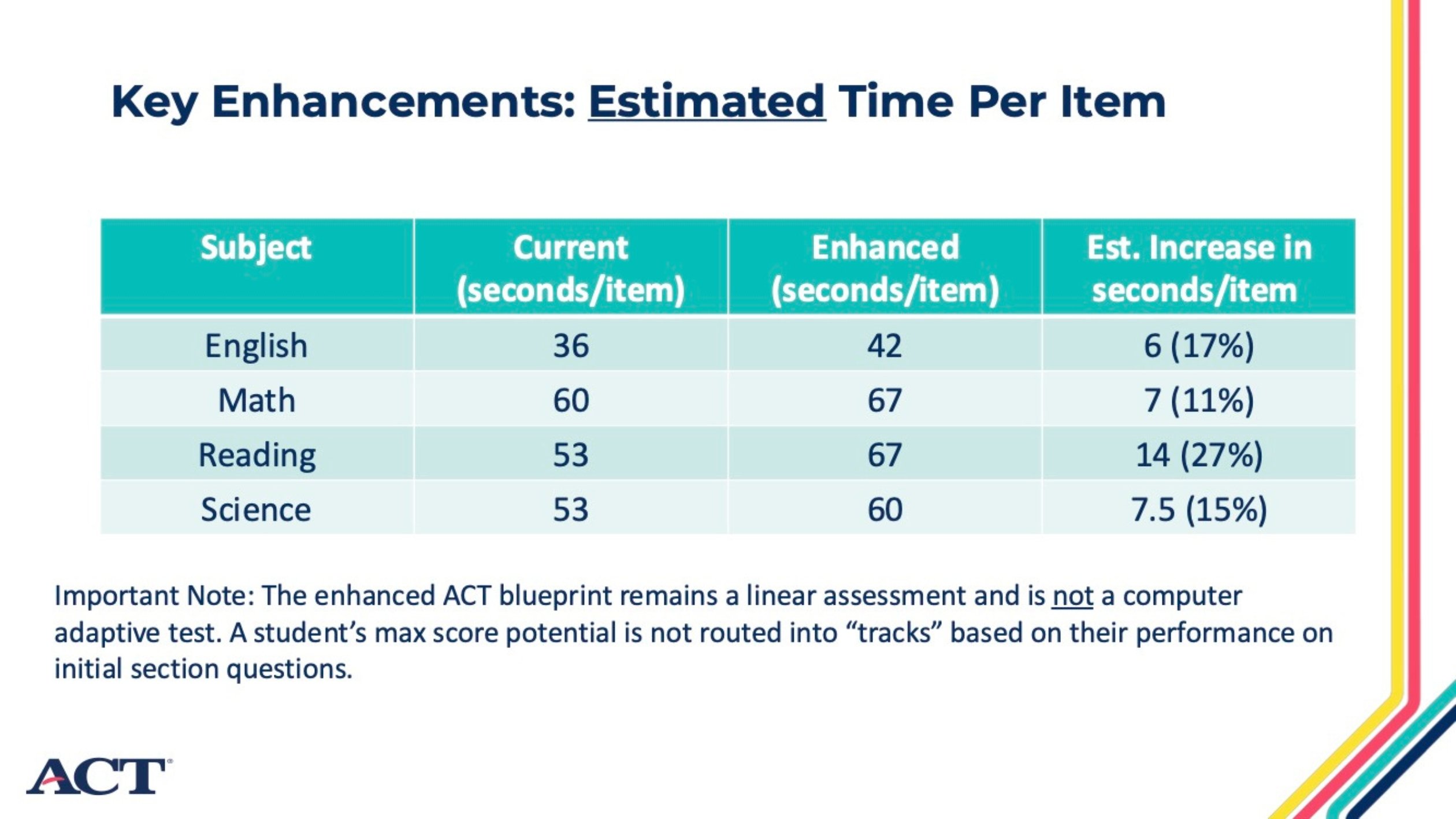
The total testing time will be reduced to 125 minutes for the composite score, significantly shorter than the current 195 or 175 minutes. To make this happen, there will be fewer questions per section. There will be approximately 44 fewer items in total across the English, Math, and Reading sections. These changes will make the total test time comparable to that of the digital SAT.
Change #3: Optional Science Section
Students can choose to take the Science section. If selected, it will appear as a section score and be used to calculate the STEM score but will not be included in the composite score calculation.
The Science section requirements will continue to vary across colleges and programs. The ACT expects varying requirements at both the school and program admission levels. Additionally, all data, including composite and subject scores, will be used for class placement and scholarships.
Change #4: Less Reading
The ACT will feature shorter passage lengths in the English and Reading sections. This contrasts with the SAT, which has removed passages in favor of short paragraphs. Previously, the ACT offered a stark contrast, allowing test takers to choose based on whether they were better at grasping longer narratives or parsing dense paragraphs. While the ACT will continue to offer multi-paragraph passages, they will not be as long, making the test more approachable for students who were daunted by the length of the passages.
Change #5: Question Content
The following changes are being made to the English, Math, Reading, and Science Sections:
English Section
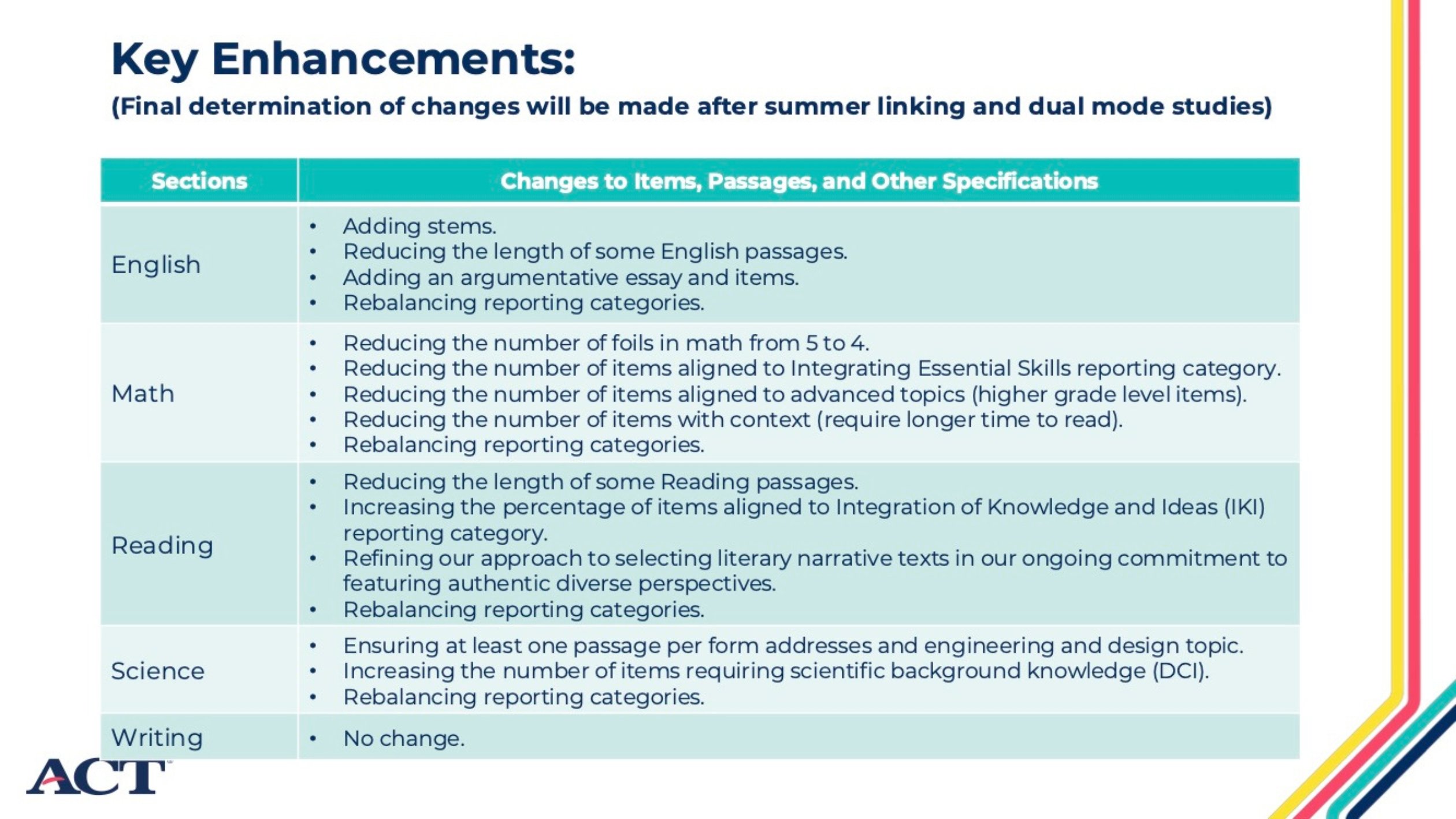
- Adding Stems: Each question will include an introductory statement to guide students’ understanding of the context.
- Shorter Passages: The passages will be more concise.
- Argumentative Passages: Some passages will now be argumentative.
Math Section
- Fewer Answer Choices: Multiple-choice questions will have fewer incorrect options, making it a bit easier to pick the right answer.
- Essential Skills Integration: More questions will integrate several skills rather than test them individually.
- Advanced Topics: Some new, tougher topics will be added to challenge students.
Reading Section
- More Integration of Knowledge and Ideas: There will be more questions that ask students to combine information from different parts of the text.
- Diverse Literary Texts: Expect to see a broader range of stories and writings from different cultures and viewpoints.
Science Section
- Design and Engineering Focus: Each test will include at least one passage dedicated to design and engineering topics.
- Increased Emphasis on Background Knowledge: More questions will test students’ learned understanding of disciplinary core ideas.
Ensuring Score Consistency
The benefit of longer tests is that they tend to report scores more consistently. By shortening the test, the ACT sought to verify that they weren’t undermining score consistency. Additionally, they want to ensure that the old and new versions of the ACT produce similar results. They have already conducted initial simulations and studies to confirm that scores will not significantly differ between the old and new ACT forms. So far, the simulations testing consistency indicate positive results. These efforts will continue throughout the upcoming academic year to ensure that scores remain comparable year after year.
Field Test Items: Placement and Scoring
The new ACT will incorporate experimental questions, referred to internally as “field test items,” directly into the test itself. Previously, these questions were included in a separate fifth section. The ACT has clarified that the placement of field test items will vary from form to form, and specific details about their placement cannot be disclosed. Importantly, field test items will not contribute to a student’s score. Only questions that impact a student’s score will be included in the Test Information Release (TIR) materials.
Impact on Previous Scores and Superscores
A significant concern for rising seniors and other students is whether their previous composite scores will be recalculated in light of the new enhancements. The ACT has confirmed that previously issued scores and super scores will not be recalculated. For students taking the test post-transition, their composite scores will be based on the English, Math, and Reading sections. New super scores will also be calculated from the best scores in these sections.
Concordance Between ACT and SAT Scores
Despite the upcoming changes, studies indicate no significant impact on ACT scores. Consequently, current plans must be revised to adjust the concordance tables between the ACT and SAT. Any future updates to these tables will follow the typical iterative process.
Availability of Practice Materials
For students preparing for the paper test, the “Preparing for the ACT” booklet will include one full practice test. Digital practice tests will also be made available. Additionally, the ACT collaborates with Wiley and other education companies to update test prep materials, ensuring students access relevant resources.
Testing Platforms and Tools
The ACT will continue to use the PSI platform for international students and the Pearson TestNav platform for state and district (school day) testing. The Desmos calculator, currently available on the Pearson platform, is also planned to be introduced on the PSI platform. New annotation tools will also be added, although we don’t have details on what those will be.
Rollout Schedule: When ACT Enhancements Will Take Effect
In October 2024, the ACT will allow students to take the new form of the ACT, providing the test at no cost to around 8,000 national test takers. This will be entirely voluntary. Participants will receive college-reportable scores. Despite the new structures, the latest ACT aims to allow students to demonstrate their knowledge effectively, given the additional time per item.
National testing done online for the April, June, and July 2025 ACTs will use the new ACT form. During this transitional period, other test takers can choose between the existing paper format and the new online format. In many parts of the United States, the existing paper ACT will remain the most common available option.
Starting in September 2025, the enhanced form will be used for both the online and paper versions of the ACT—identical for national and international students. This change will take place in Spring 2026 for state and district testing.
International Testing Options
Due to ongoing supply chain delays and security concerns, the ACT will continue to offer the digital version of the test internationally, with the exception of students requiring accommodations that can only be met through special testing services.
Alignment of PreACT and WorkKeys Tests
The ACT plans to align the PreACT and PreACT 8/9 tests with the new test blueprint. However, no current changes are scheduled for the WorkKeys tests (an assessment that tests students’ job skills in applied reading, writing, mathematics, and Essential Skills).
Reporting Science Scores
Currently, students cannot opt out of reporting individual subject scores, including Science, once they have been taken. The ACT evaluates the possibility of allowing single-subject score suppression to serve students’ needs better.
Questions Test-Prep Experts Have About the Enhanced ACT
Will students be able to leverage the science choice to “game” their Composite score?
A: No. All Composite scores from all ACT programs (National, International, State & District, paper, online) will move to the new EMR calculated Composite score starting September 2025. This provides students and higher education with a consistent change over to the new calculation for all tests from that point forward.
Allowing students to choose to take the ACT with or without science does not impact the Composite score distributions across the population of applicants. If a student elects to take the science section, we will provide their science section score and STEM score on all reports; this includes sending those scores to institutions of higher education and other programs that have used these scores in the past.
When will practice materials be available?
A: We are working right now to provide practice opportunities that reflect the new test-taking experience. We are making an addendum to the 2024-2025 Preparing for the ACT guide that highlights differences between those preparing for September through February administrations, and those preparing for the Online administration in April, June, and July.
In addition, we are working with our administration vendor so that we are able to put practice tests into the platform that students will use on test day. We will be putting practice tests for both the current format of the online assessment, followed by the ACT enhancement format into the platform, and will announce when they are ready.
Will the types of items on the ACT be changing? Or more the structure and length?
A: The ACT test will continue to feature multiple-choice items in the English, math, reading, and science sections, and an open-ended prompt-based essay in writing. The standards and skills measured by the enhanced blueprint will remain comparable to those measured in the current ACT. Reporting categories will maintain the same meaning but may be rebalanced proportionally to accommodate stakeholder feedback. By and large, the content of practice materials that are currently available will provide students with experience on the content of questions that ACT will continue to ask.
As noted in the presentation, the structure of some of the items will change (English and math are most affected). In addition, the balance of items that align to the reporting categories in each subject is shifting, therefore, there may be more or fewer items that test specific topics.
Is there a cost difference to the student to take the ACT with or without science?
A: Final pricing will be set prior to the opening of registration for the April administration window. Our intention is to provide a “core” version of the ACT containing English, math, and reading that is less expensive than today’s four-section ACT. ACT remains committed to our fee waiver programs which will continue to apply.
Takeaways from the New ACT Changes
More updates will be forthcoming as the ACT rolls out these changes. Students and educators crave, perhaps more than anything else, to see a living, breathing practice test. You can find those updates here on the NTPA blog when the details are released.
Article Summary
Major Enhancements to the ACT
- More time will be allowed per question.
- The new test will be shorter in length.
- The science section will be optional.
- Reading passages will be shorter, doing less reading throughout.
- Less significantly, minor changes will be made to the questions asked.
Rollout Schedule
- In October 2024
- Students will have the optional opportunity to use the new ACT form.
- April, June, and July 2025
- National testing done online will use the new ACT form.
- Other test takers can choose between the existing paper format and the new online format during this transitional period.
- September 2025
- Both the online and paper versions of the ACT will be the new form for national and international testing.
- Spring 2026
- Both the online and paper versions of the ACT will be the new form for state and district testing.
About the Authors
 Ari Freuman began tutoring in 2013, primarily serving Northern New Jersey and New York students. In 2020, he founded Ivy Tutor to address the need for proficient SAT and ACT tutors, building a team of dynamic and inspiring educators. Ari holds a master’s degree in psychology from SUNY New Paltz and a second Master’s in Statistics, leveraging his academic background to help students maximize their test scores. Based in Hoboken, New Jersey, Ari teaches students worldwide through virtual sessions. Additionally, Ari serves on the NTPA blog committee, contributing his expertise to the organization’s outreach efforts.

Marc Gray, owner of Odyssey College Prep and CEO of Powerful Prep, streamlines college admissions with advanced aptitude testing. An active blogger, he writes on college admissions, test prep, and aptitude testing. As Chair of the NTPA’s Blog Committee, he updates members on the latest in test prep, college admissions, aptitude testing, and community news.
Last Updated on February 13, 2025 by Marc Gray
Regarding the price difference: The ACT has told me that the price without science will be only $4 lower than the price with science.
There are still not true practice materials out there for the enhanced ACT.